Digging deep for energy and lithium & A New Chapter for South Crofty?
Digging deep for energy and lithium - ANDY CHATFEILD
On our doorstep, a new mining revolution is taking place. It might be less dramatic than the tin and copper ‘goldrush’ which did so much to transform our landscape and economy, but it is again putting this part of Cornwall in the record books.
In February, the United Downs deep geothermal plant launched in earnest. Thanks to two very deep holes – one of them the hottest and deepest onshore well in the UK – this 21st-century ‘mine’ is doing two things: extracting large amounts of much-needed lithium carbonate from deep underground while also generating enough geothermal energy to power around 10,000 homes.
The power is going into the National Grid. The minerals are going to a company in Basingstoke to be processed into battery-grade material.
Economically, this is not an operation which will directly transform the lives of thousands as mining once did here. But its local impacts should not be underestimated, says Ryan Law, founder and CEO of GEL, the firm which runs it.
“Projects like United Downs further position Cornwall as a leader in clean energy innovation, which we hope will attract further investment and future development opportunities across the region,” he says. “This is a project that is rooted in the local area and designed to be replicated at other sites in Cornwall, reinvigorating traditional industries.”
The firm has also committed to use as many local service providers, contractors and hospitality outlets as possible. Law says that over £2.5 million has been invested in the local economy already, along with £40,000 to launch a community grant fund which is already benefitting grassroots organisations.
He adds: “While geothermal projects like the one at United Downs are not large-scale employers in the same way as heavy industry, they do create highly skilled technical roles in engineering, geology, operations and maintenance, and GEL prioritises job applicants who already live in Cornwall or who grew up in the area.”
Initial local fears – understandable but inaccurate – that the project could be as potentially disruptive as controversial ‘fracking’ operations elsewhere have been allayed, he hopes.
Despite the many differences between this plant and the many local mines of the past, he is also keen to emphasise continuity.
“GEL certainly has a very strong awareness of the history of the United Downs area and the wider Camborne–Redruth mining district.
“This is one of the most important historic mining regions in the UK for tin and copper, and indeed Europe, with a legacy built on tin and copper extraction that helped shape modern industrial engineering.
“The geology of Cornwall, which made it such an important area for mining in the past, is also precisely what makes it so suitable for geothermal development today.”
The precise benefits for Redruth and its neighbouring villages are likely to become clear only in the coming years. But together with the revival of South Crofty, the United Downs plant is certainly adding an arresting new chapter to this district’s industrial history.
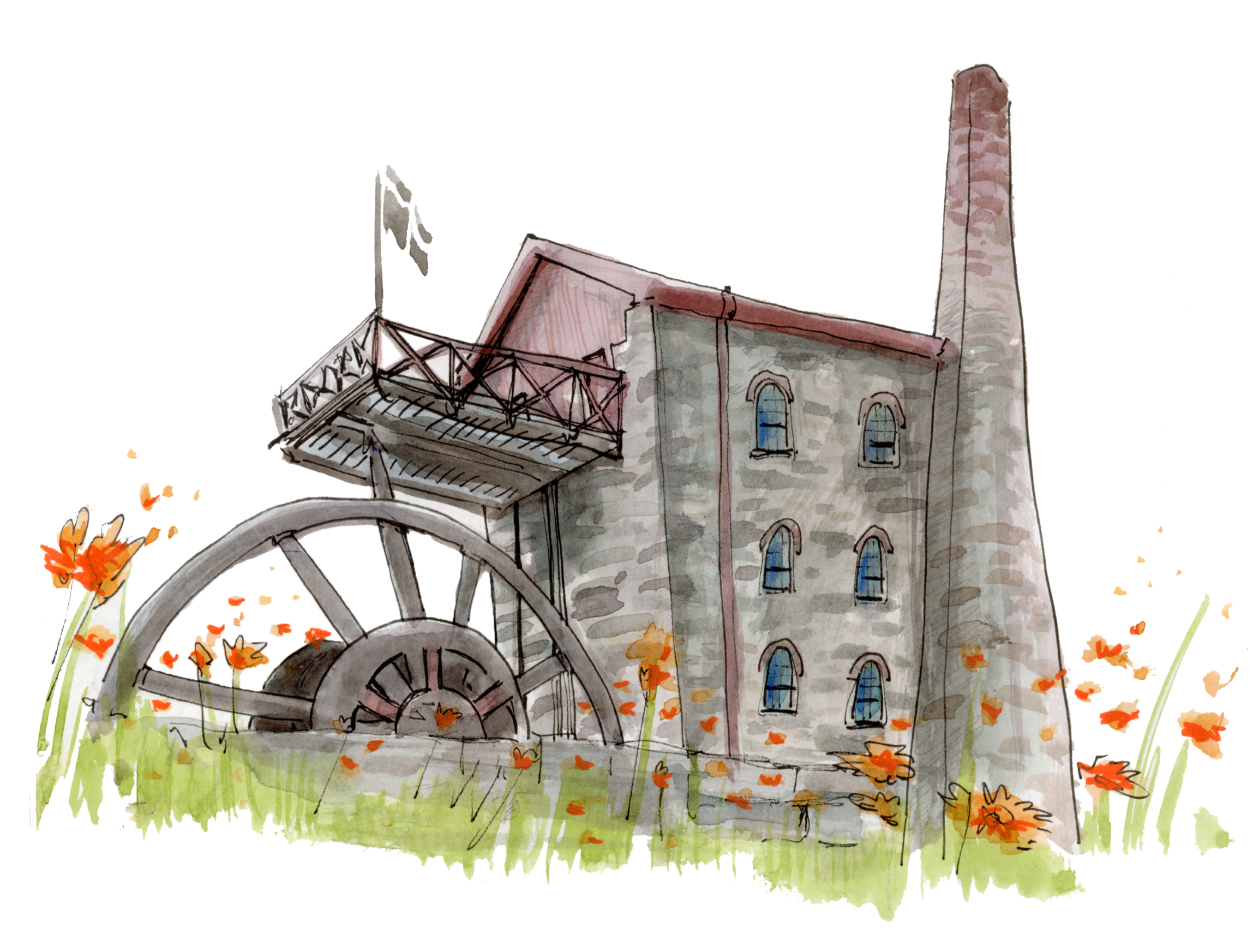
A new chapter at South Crofty? MARLA PAYNE
After several unsuccessful attempts to revive it, is there finally going to be a mining comeback at the famous mine in Pool? It looks like it will finally happen, reports MARLA PAYNE
South Crofty mine in Pool has been in operation since as far back as 1592, still providing nearly 300 jobs at the time of its closure in 1998. Mining at South Crofty has historically been a cornerstone of community, employment and identity in Pool, Redruth and the surrounding areas, as well as being a major supplier of tin domestically and worldwide. However, after tin prices took a dive in the 1990s, the mine was forced to close.
So what’s going on at South Crofty mine now? After years of uncertainty and failed attempts to revive it, there’s hope on the horizon, as definitive steps are finally being taken towards its restoration as a going concern.
Baseresult attempted to reopen South Crofty in September 2001, and parts of the mine were even opened for tourist visits before further work began. Galena LLP then invested too, to form Western United Mines, a company that continued to finance South Crofty in November 2007.
The extent of work needed to continue mining operations soon became clear – the mines needed dewatering due to extensive flooding, which required a high level of investment.
Unfortunately, Western United Mines’ main investor was unable to continue their support, and so plans to continue the restoration were halted in June 2013.
In 2016, Cornish Metals (then known as Strongbow Exploration) bought South Crofty, and in 2023, they began to dewater the flooded tin mine. By early 2025, it had already cost them around £4.4 million.
However, in the same year, Cornish Metals was able to secure £28.6 million in investment from the UK National Wealth Fund.
With further fundraising, £57.4 million was raised in total to continue the mine’s restoration.
There has even been recent speculation that US President Donald Trump has now invested in the mine’s restoration – however, this is not strictly true.
In February 2026, the Export-Impact Bank of the United States (EXIM), which is backed by Trump’s administration, sent a Letter of Interest to Cornish Metals, which expressed their interest in investing up to £166m in the project.
While Cornish Metals is yet to formally respond to the letter, the Cornwall Green Party has expressed its disapproval of the potential investment.
Co-Coordinator Tom Scott wrote on the party’s website: “This would be a deal that puts ‘America first’, not Cornwall… We hope that both Cornwall Council and the UK government will make it clear that they reject any arrangement of this sort proposed by the Trump administration.”
Regardless of potential investors, Cornish Metals is estimating that the mine will be open for tin extraction by mid 2028.
Cornish Metals are confident that reopening South Crofty mine will have positive impacts on the local area.
They have estimated that the mine will employ over 300 people directly, into both highly skilled and well-paid jobs, and create up to 1,000 indirect jobs, with the influx of workers creating a demand for local goods and services, and jobs created in construction and the supply chain. The company says it is already employing around 100 people.
Locals have had mixed reactions to the idea of the mine reopening. According to a survey conducted by the Made in Redruth team, nearly 90% of the respondents wanted the mine to reopen, with only 5% expressing concerns about its revival.
Whilst the majority are keen, as it will provide employment in the local area, others have cited fears that the activity will cause noise, environmental hazards and an increase in traffic, with one person asking: “Will local people be compensated for the disruption to their lives?” Some are sceptical that the project will generate enough jobs to make it worthwhile.
What is not in doubt is the symbolic significance of a famous mine reopening in the heart of a community whose very foundations were created by the industry.
ILLUSTRATIONS: ABI JONSTON (watercolour); DAWIN RACYTE (digital)