The Next Frontier for Cornish Theatre
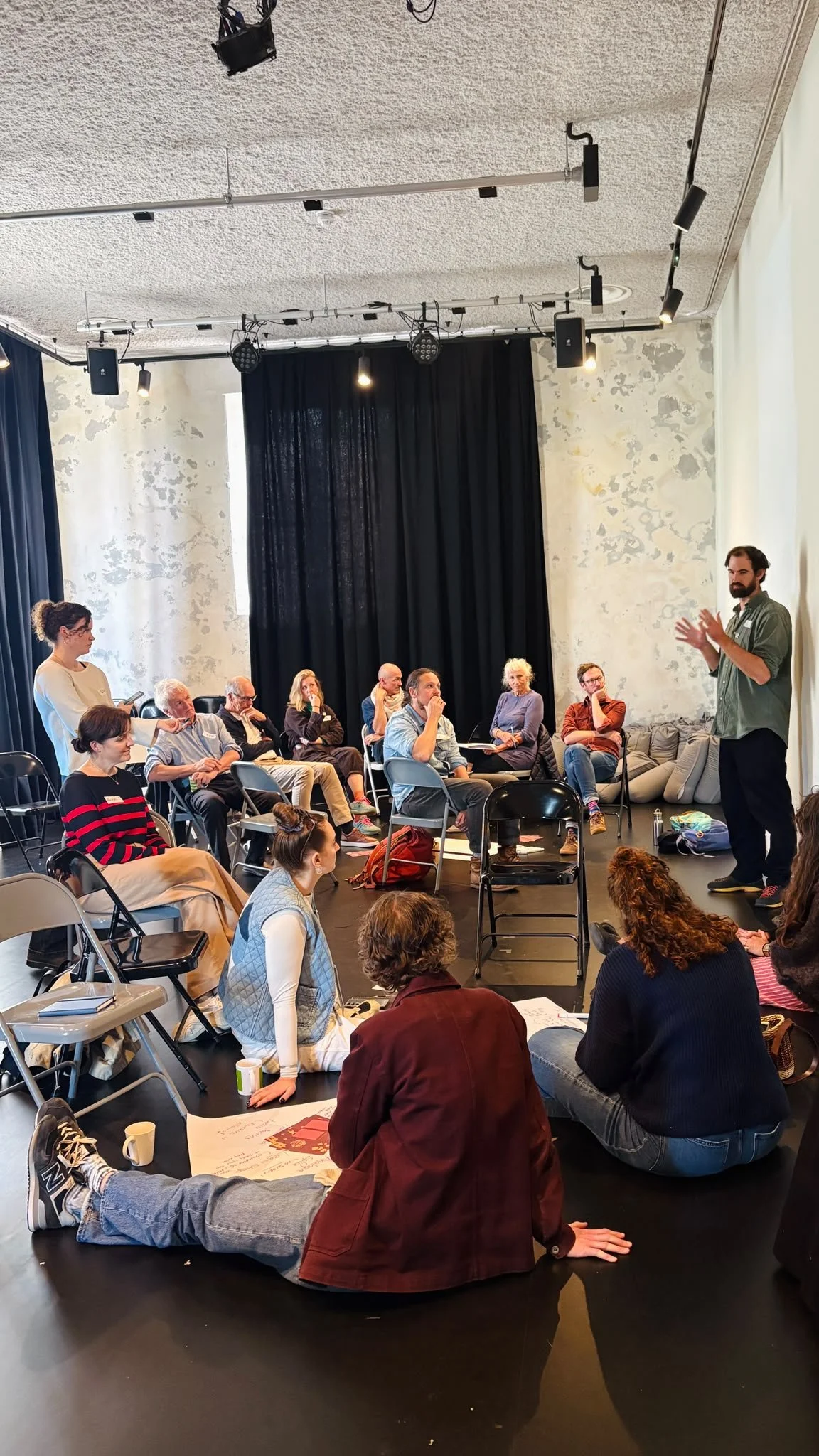
Symposium
This blog captures ten talks from Cornish theatre makers on their ideas about the future of Cornish theatre.
We welcomed representatives from the Cornish theatre community to breakfast, to have an opportunity to see our play, The Collector, and to contribute to our consultation on Bill’s Attic. I’ll cover those in separate posts. All in all it was a packed morning of pastries, bhajis and chatter.
The centrepiece of the day was thrown over to the theatre and performance community to discuss what the next frontier for Cornish Theatre. Cornish theatre has never had much money but what stood out was how little that stopped companies from innovating and playing. Across ten talks, makers described the frontiers they are working at: community, access, price, climate, place, and even the survival of their form.
Making the work is the hard part
Sally of Miracle Theatre set the tone: “It feels like an absolute triumph when we finally get into a rehearsal room to start making,” because too often the company arrives “tired, under-resourced but very grateful to be there.” Julie Caplin-Grey, Deputy CEO of Hall for Cornwall, who is leaving Cornwall after 30 years working here, put numbers on it. Arts Council spending is about £8 a head here, against £12 over the border in Devon or £48 in Plymouth. In all those 30 years, she said, “there’s never money to make the work.”
Yet the work gets made. Gabby and Charlie of Impossible Producing built a festival on stubbornness. They were told Cornwall wasn’t ready for ambitious contemporary performance, and disagreed: “If you bring brilliant contemporary performance [here] people will watch it,” and they “sold everything out by WhatsApp.” Their advice to anyone starting out is to ask for their help: “For £30 for 30 minutes we might save you three weeks of work.” plugged Charlie.
Deeper, not bigger
For Miracle Theatre, the next frontier “isn’t about making bigger shows, it is about deepening our work with the communities that we reach.” Their stages in fields and car parks are really about creating a space for people to gather. Even a heatwave helped: when an earlier start time went unannounced, the waiting audience simply began “an impromptu social connection garden party.”
Fin from Into:Bodmin described the same instinct in Bodmin. He came back to a town many called a “cultural desert” and found that “any desert is a seed bank waiting to grow.” His principle: “We didn’t want to do culture to Bodmin; we wanted to do culture with Bodmin.” That meant listening first, then a youth-led pot noodle bar on the high street, school carnivals, and an old library turned into a hub. “When you make it with and not for, people feel that sense of pride and that sense of ownership.”
Working at the edge
Alistair of Urban Playground and Creation Works sees the periphery itself as a frontier. His company, based in Par, is making A Par Bay Tempest around a pressing question: “Can the Tempest hold back the flood?” With 800 properties in the area at risk of flooding, the show doubles as a way to build a community-led adaptation plan. The company’s approach is long-term commitment to Par rather than parachuting artists into a place for a project and leaving.
Who gets through the door?
Two speakers tackled barriers to attendance from different angles:
Jasmine Cole of Coppice Theatre argued that access should be designed in from the first page, “not as an add-on.” Access costs go into the funding bid alongside set and costumes, and captions, Makaton signing and audio description are written into the script. Her conclusion: the next frontier is “redesigning the way that we make,” so that companies ask not only who will direct and design, but “who’s going to bring all this access into our show.”
Nathan of Wildworks took on a line printed on their flyers, “everyone is invited”, and he asked how true it really was. The biggest barrier was price. For their summer production of Kneebone Cadillac, a Cornish comedy set in the world of scrapyards and banger racing, staged at United Downs Raceway, they tried what they called radical pricing: five ticket types, from Patron (£70) through Solidarity (£40), Standard (£25) and Community (£10), down to Pay What You Decide, from just £1, “no questions asked.” The community ticket, Nathan stressed, wasn’t meant to look like charity: “It was just another valid choice, depending on your financial circumstances.”
The results beat the targets they had set beforehand. Against the 2024 run at the same venue, average attendance per performance rose 7% and average revenue per performance rose 9%, while the average ticket price barely moved (£16.89 to £16.84). Over 700 ticket buyers left feedback, and about 28% of responses mentioned affordability. More than 30% of the audience hadn’t been to the theatre in the previous year, a figure that doesn’t include the racing community, who were invited directly and arrived in convoys, many seeing theatre for the first time. “A third of people not having been in the previous 12 months, that feels like success.”
Would they do it again? Yes, and more boldly: “£1” on the poster, a slightly pricier standard ticket, and a standard concession ticket, since people kept buying £10 community tickets when they really wanted a child’s ticket.
Theatre for everyone, everywhere
Peter of Motion Sickness quoted Martha Graham: “Theatre is a verb before it is a noun.” His company plans to make two versions of each show: a free, stripped-back acoustic version for village greens and harbour walls, and a full “deluxe” version for theatres. His case for collaboration was a hopeful one: “a strong scene makes stronger work.” And he asked, “Why shouldn’t Cornwall... be at the beating heart of it?”
Don’t forget dance
Sally of Cscape reminded the room that dance keeps getting left out of the conversation. “Dance belongs everywhere,” she said, and for many Cornish people their first live professional dance is on a beach or in a town hall. But there are roughly 200 theatre NPOs in England against about 70 for dance, and she warned that losing dance means losing “the whole theatre ecology of Cornwall.” Her ask of venues and funders: “Dance is not an optional extra.”
A time of hope
Sue Hill took us on a journey into the unpredictable magic of the outdoors; crows scattered into the air, performers waist high in the tide and hell’s angels careering down clay pits full throttle. The transience of spending three weeks camping in Carn Marth to build a boat just to burn it. Sue gave us a context of Cornish theatre, it’s resourcefulness and unmistakable flavour.
Julie Caplin-Grey closed on the day’s clearest message. The sector has “lost the knack of having sharp elbows” and should tell its story together, in the rooms where decisions are made. But she also said: “It’s a time of hope... Find the roots. Find the next thing.”